


Exploring Chhattisgarh’s Rich Folk Culture: Pandavani Tradition
The Mahabharata, meaning 'Great Epic of the Bharata Dynasty' in Sanskrit, is one of the most revered literary works in Indian and world literature. The central story revolves around two cousin clans - the Pandavas and the Kauravas (the Pandavas are sons of Pandu, and the Kauravas are sons of Dhritarashtra), who fight for the throne of Hastinapur during the Kurukshetra war. Philosophical discussions and a number of short stories about living or deceased people are mentioned throughout this epic.
The authorship of the Mahabharata has been attributed to Krishna Dwaipayan Vyasa, who is also a character in the epic. According to various sources, Lord Ganesha recorded the verses after Vyasa dictated them. Scholars generally date the original composition of the Mahabharata to the 4th century BCE or earlier, with the epic evolving and expanding over subsequent centuries and reaching its final compiled form by the 4th century CE, and at 100,000 verses, it is one of the longest epic poems ever written and is considered the longest epic in Sanskrit literature.
Additional Info
The Mahābhārata, one of the two major Sanskrit epics of ancient India, developed over centuries through oral traditions and successive redactions, making precise dating challenging. Scholarly consensus holds that its core narrative—known as the Jaya (a proto-version of about 8,800 verses)—likely originated around the 8th or 9th century BCE, shortly after the early Vedic period and before the rise of the Maurya Empire. This earliest composition would have been a shorter heroic tale centered on the Bharata clan's conflict, which Panini (c. 4th century BCE) may have referenced in his Aṣṭādhyāyī. The expanded Bhārata version (24,000 verses) was probably composed by the 4th century BCE, as suggested by early texts like the Aśvalāyana Gṛhyasūtra. The full epic, as we know it today (over 100,000 verses), reached its bulk form between the 3rd century BCE and 3rd century CE, with final redactions by the early Gupta period (c. 4th century CE). Oral precursors may extend further back into Vedic times (c. 1500–500 BCE), but no written manuscripts predate the Kuṣāṇa period (c. 200 CE).
Numerous excerpts or stories from the Mahabharata have been retold in the Kavya genre within Sanskrit literature itself, both in its Drishya (visual) and Shravya (auditory) forms. The epic has numerous regional retellings. Sanskrit literary scholarship has already examined these retellings from a number of angles. However, there are still significant opportunities for new research in this field, especially on topics like the relationship between artistic freedom and traditionalism. The text has been constantly retold in various regions of India as performances, songs, and ballads and has been constantly reinterpreted, shaping its themes in order to reflect local memories.
One such lesser-known tradition is Pandavani, the Narratives of the Pandavas, performed by the Chhattisgarh tribes, majorly the Pradhans.
The term "Pandavani" originates from "Pandavas", which refers to the five legendary brothers - Yudhishthir, Bheema, Arjuna, Nakula and Sahadeva - who are the main figures in the Mahabharata. The performances focus on the courageous acts, challenges, and hardships faced by the Pandavas, highlighting their battles against evil and their quest for justice. Bheema (the 2nd Pandava) is mostly a central character of the Pandavani. Episodes of Vana Parva and Virata Parva seem to be much more popular in the Adivasi and folk consciousness of the Central India region.
The Pandavani art form features two primary styles: Vedamati and Kapalik. In the Vedamati style, the storyteller, known as the Vedamati, narrates the tales while playing the “Bhumbo”, a traditional string instrument similar to a tambura. The narration is supported by a group of musicians utilising various instruments such as the dholak, harmonium, and manjira, producing a rhythmic and harmonious accompaniment to the story. A solo performance in the Kapalik style, on the other hand, entails the artist not only narrating but also acting out the various epic characters, differentiating them with facial expressions and voice modulations. Dramatic and creative talent are essential for this approach.
From Heroic Masculinity to Feminine Agency: Evolution of Pandavani
Early Male performers:
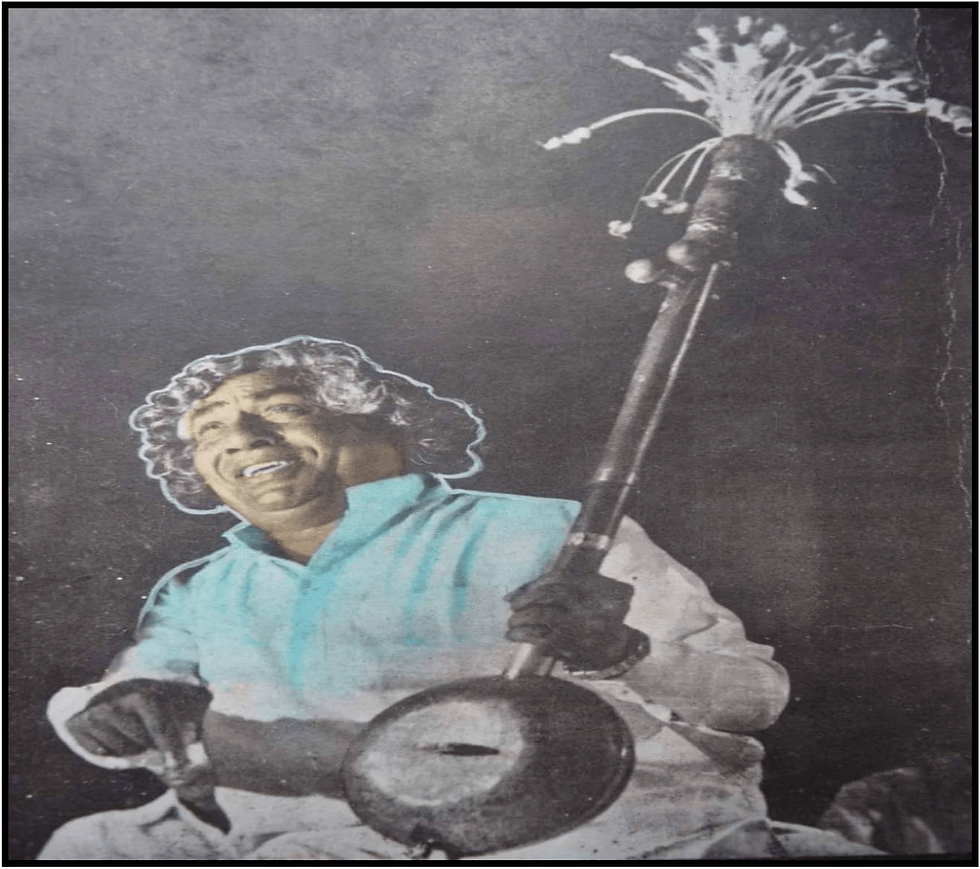
Narayan Lal Verma and his Ragi, alias the mama-bhanja duo, are the earliest known Pandavani singers in local memory. Other early artists include Jhaduram Devangan, who established this form outside rural spaces, performing in cities and on All India Radio. His style was predominantly Vedamati. Traditionally the Pandavani was performed by male artists focusing on stories around heroic masculinity (Bheema, Arjun) and valour. Draupadi and other women appeared but mostly as secondary figures. Also, gender norms of rural society restricted women from participating as performers. The full performance of Pandavani used to take eighteen evenings to perform, but such long performances could not attract people. Hence, later on, shorter versions of Pandavanis came into light wherein a few stories from the epic are taken up for depiction during one or two shows.
Rise of Teejan Bai:
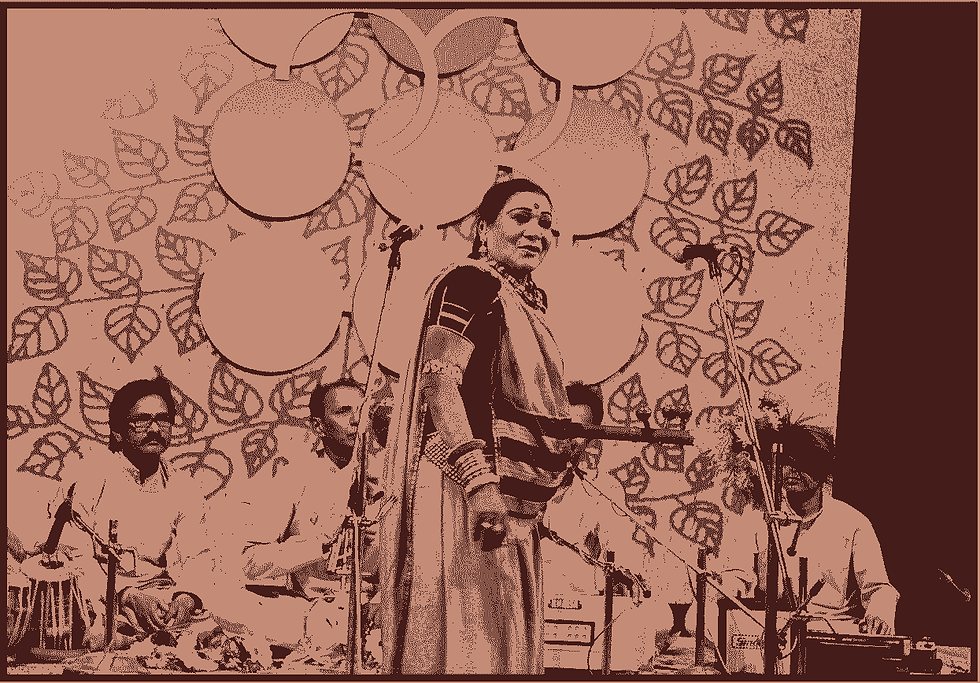
The shift in this paradigm occurred with the entry of Teejan Bai in the 1960s and 1970s. She encountered a lot of social taboos and even got expelled from her community for singing Pandavani in public. Despite the odds, she became the first prominent female performer to adopt the Kapalik style. Her debut performance was at a neighbouring village of Chandrakhuri at the age of thirteen. She was inspired by her maternal grandfather, who was a Pandavani expert. She also took some informal training under Umed Singh Deshmukh. Habib Tanvir, the famous theatre personality from Bhopal, noticed her in the 1970s and recommended her performances to several other festivals. Soon Teejan Bai was performing for the prime minister and heads of state and was hailed as the world’s first female exponent of Pandavani. Teejan Bai's rise brought Pandavani to national and international platforms, which also became a part of India's intangible cultural heritage.
Contemporary impact and modern performers:

Global audiences began to see the Mahabharata not only as literature but also as a living performance. This global visibility has inspired a new generation of performers, including women like Ritu Verma and Usha Barle, who continue to reshape the tradition while emphasising female perspectives. The stories, once centred on Bhima’s bravery, now increasingly bring forward Draupadi’s voice as a symbol of resistance and justice. Also at the same time, Pandavani has found a place in modern media and education. It appears in documentaries, academic discussions, and digital archives, expanding its audience.
Teejan Bai said, ‘I do not care what language is used to communicate these Mahabharata stories, because the gods have left them for us to educate ourselves’. _the telegraph online
This spirit ensures that Pandavani will continue to evolve, inspire, and educate, keeping the eternal flame of storytelling alive for generations to come.
About the Author Ishita Batra is a fourth-year B.A. (Hons.) History student, currently pursuing her undergraduate degree from Delhi University. With a keen interest in the intersections of literature, performance traditions, and art history, she aspires to further her research in the field of Indian cultural history, exploring how texts and traditions shape collective memory and identity.
Editor
Sachin Singh Jadoun, first member at Inarch Center.
Which tribal community is primarily associated with the Pandavani tradition of Chhattisgarh?
Gond
Pradhan
Bhil
Santhal
Sources
Attri, S. (2024). Transformed feminist spaces and identity construction: Women Pandwani performers in Indian folk theater. Journal of International Women’s Studies, 26(1), Article 13.
Das, N. K. Adivasi Mahabharata Pandavani of Chhattisgarh Gond Tribe, (p.78-90), Irish journal of anthropology. https://www.academia.edu/24331773/Adivasi_Mahabharata_Pandavani_of_Chhattisgarh_Gond_Tribe
Mishra, M. K. (1993). A hero of the Mahabharata in the folklore of Central India. In K. S. Singh (Ed.), The Mahabharata in the tribal and folk traditions of India (pp. 157–174). Indian Institute of Advanced Study. https://iks.iitgn.ac.in/wp-content/uploads/2021/01/Mahabharata-in-Tribal-Folk-Traditions-of-India-intro-by-KS-Singh.pdf
The Art Life Gallery. (n.d.). Pandavani: The folk art of Chhattisgarh. https://www.theartlifegallery.com/blog/pandavani-the-folk-art-of-chhattisgarh
Indian Culture. (n.d.). Pandavani: Folk narrative tradition. https://indianculture.gov.in/folk-art/pandavani
Doniger, W. (2025, September 6). Mahabharata. Encyclopedia Britannica. https://www.britannica.com/topic/Mahabharata
Additional Sources
https://teachmint.storage.googleapis.com/public/bce7fdc5-2f3f-48c3-8616-9bcf79bf1ec1.pdf
https://egyankosh.ac.in/bitstream/123456789/64652/1/Unit1.pdf
https://devdutt.com/what-history-and-archaeology-tell-us-about-the-mahabharata/
https://www.telegraphindia.com/west-bengal/pandavani-narrator-finds-disciple/cid/1282124

Keywords Chhattisgarh Folk Culture
Pandavani Tradition
Chhattisgarh Folk Art
Teejan Bai
Mahabharata Regional Retellings
Vedamati and Kapalik Styles
Pandavani tradition of Chhattisgarh
Chhattisgarh folk art
Pandavani storytelling
Mahabharata folk retelling
Pradhan tribe Pandavani
Vedamati style Pandavani
Kapalik style Pandavani
Teejan Bai Pandavani
Ritu Verma Pandavani
Usha Barle Pandavani
Adivasi folk narrative
Central India Pandavani
Pandavas Narratives
Feminine agency Pandavani
Draupadi folk performance
Indian intangible cultural heritage
Folk performance Mahabharata
Bhumbd instrument
Dholak harmonium manjira accompaniment
Digital archives Pandavani


https://8xbetplus.net/ ừ đúng rồi, kiểu lúc ngồi lướt linh tinh trong giờ nghỉ mình ghé qua xem cho biết, không phải để đọc kỹ gì đâu, chỉ muốn coi họ bày trang ra sao mà kéo xuống một cái là thấy mấy tiêu đề to đùng hiện rõ ràng nên mắt bắt chữ nhanh, đoạn “cập nhật link vào trang chủ” nằm khá ngay ngắn ở phía trên nên ai cần đường dẫn chắc khỏi phải tìm vòng vòng; mình còn để ý có cái bảng theo dõi trạng thái đường dẫn nhìn dạng cột, liếc qua là biết cái nào đang ổn cái nào có vấn đề. Menu để chỗ dễ thấy. Cuộn trên điện thoại cũng không bị…
nói về mấy trang phát bóng đá giờ hay khoe đủ thứ thông số, nhưng cái này nhìn vào là hiểu ngay; cakhiatv mình vào thử trên điện thoại trước, lướt xuống một đoạn là nắm được lịch đang có gì, chữ với khối nội dung tách rõ nên mắt đỡ phải dò, chuyển qua máy tính cũng giữ bố cục ổn, bấm qua lại vài mục vẫn biết mình đang ở đâu; mình để ý ngay chỗ hiển thị trận họ ghi Full HD 1080p với 60fps khá thẳng thắn, khỏi phải mở nhiều chỗ để đoán chất lượng, cảm giác làm cho người xem nhanh gọn; nói chung không có gì màu mè, chỉ cần tìm trận và…
https://aplicativo.br.com/ Entrei meio no impulso, só pra dar uma olhada rápida, e acabei ficando mais tempo do que eu imaginava. O que gostei é que eles não enrolam: a info vem bem organizada e dá pra entender sem ter que garimpar no texto. Achei bem útil eles deixarem a fonte oficial e a data da última verificação aparecendo de um jeito bem visível, porque hoje em dia tem muito conteúdo que parece largado. Também curti que a explicação das permissões é em linguagem simples, sem aquele juridiquês chato. Não é aquele site que tenta empurrar ranking ou “melhor de tudo”, parece mais um lugar pra conferir o básico com calma. No fim, o padrão de ficha com fonte e data…
98 WIN mình thấy mọi người nhắc hoài nên cũng ghé thử cho biết, kiểu vào xem giao diện có dễ dùng không thôi. Mình lướt vài phút là thấy trang làm khá thoáng, chữ nghĩa rõ ràng, kéo xuống không bị ngợp vì họ chia nội dung theo từng khối nhìn rất “ngăn nắp”. Có đoạn giới thiệu ghi nền tảng ra mắt từ tháng 12 2018 và đặt trụ sở ở London, đọc qua thấy họ viết thẳng thắn chứ không vòng vo. Mình cũng thích cái cách họ để tiêu đề to, tách ý gọn nên tìm thông tin nhanh, không phải dò từng đoạn dài. Nói chung trải nghiệm lướt trên điện thoại ổn, và mấy…
Hi 88 mình thấy kiểu bố trí này hơi giống mấy trang mình từng lướt trước đó, nhưng cảm giác mọi thứ nằm “đúng chỗ” hơn nên nhìn một cái là biết nên đi đâu tiếp. Mình chỉ vào xem cho biết thôi, không đào sâu nội dung, chủ yếu để ý cách họ trình bày thông tin: các khối nội dung xếp thành từng mảng rõ ràng, kéo xuống là thấy phần nào ra phần đó, nên mình lướt nhanh vẫn không bị lạc. Menu để ở vị trí dễ nhìn, bấm chuyển qua lại giữa các mục cũng trơn tru, không phải vòng vèo nhiều. Có mấy bảng thông tin dạng cột nhìn gọn gàng, chữ và khoảng…